Understanding Restorative Practices in Schools: 4 Models to Foster Trust, Repair, and Connection

Restorative practices—broadly defined as "the science of relationships and community"—offer schools a powerful alternative to punitive disciplinary practices such as suspension or expulsion. Restorative practices focus on repairing harm, building relationships, developing a strong classroom and school community, and addressing the underlying causes of challenging behavior. A growing evidence base demonstrates that schools implementing restorative practices consistently experience improved academic outcomes, increased student engagement and motivation, fewer behavioral problems, improved school climate, and enhanced social-emotional learning.
As of July 2025, Connecticut Public Act 23-167 requires regional and local boards of education to adopt and implement policies to respond to nonviolent school discipline incidents using evidence-based restorative practices. The law gives school leaders considerable flexibility to identify and select practices that best fit their district's needs, but that flexibility can also be overwhelming. Consistent and structured implementation can be challenging for schools due to the wide range and complexity of the concepts, skills, and tools that fall under the "restorative practices" umbrella.
Key Definitions
The first step to implementation is to define what we mean by "restorative practices" and to understand what they look like in action, so that schools can thoroughly assess potential barriers and readiness to begin.
While there are many examples of restorative practices, the four described below—all exemplifying accountability, collaboration, fairness, mutual respect, and healing—can serve as a starting point.
To learn about other common restorative practices and see our recommendations for Connecticut schools, take a look at our 2025 Issue Brief: A Restorative Approach to School Discipline.
4 Essential Restorative Practices Used in Schools
1. Listening Circles
A listening circle is a structured process that brings together affected individuals to discuss harm and healing, with a focus on turn-taking, open dialogue, and consensus-building. How it works:
- Structured turn-taking ensures each participant has the opportunity to speak and to listen; a talking piece can be used to facilitate this process.
- In an open dialogue, participants are honest about what has happened, who was impacted, and how, giving students a safe space to express opinions and connect.
- Consensus building is a process that begins to repair harm, involving all participants in a collaborative resolution.
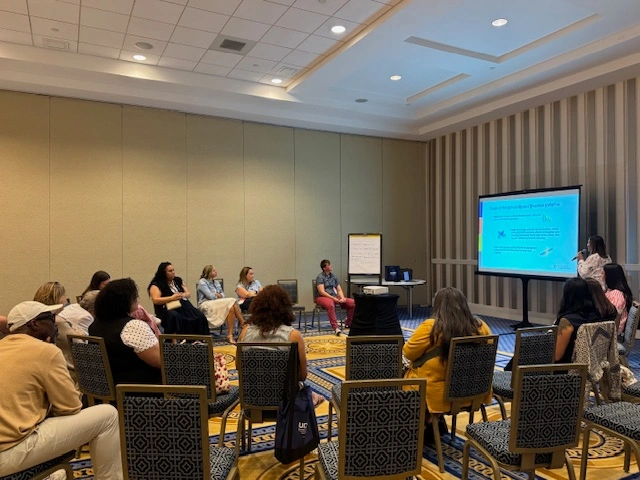
CHDI's Yecenia Casiano co-leads a workshop at the Innovations Institute's 2025 Training Institutes in Maryland. The workshop included a demonstration of listening circles.
2. Peer Mediation
In peer mediation, neutral, trained student mediators help peers collaboratively resolve conflicts through confidential, guided discussions. How it works:
- Schools develop a voluntary peer mediation training program, guided by their school's values and culture.
- In each mediation session, peer mediators deliver an opening statement that establishes their impartiality, explains their role, and establishes ground rules for the session.
- Both mediators and participants are empowered to develop conflict resolution skills like perspective-taking, active listening, and empathy.
3. Community Circles
Community circles are gatherings designed to strengthen community bonds and support relationships among students, staff, and families, with an emphasis on collective responsibility. Benefits of this practice include:
- Proactively fostering positive relationships between peers, students, staff, and families
- Creating a space where every student is seen, heard, and valued
- Normalizing the "talking circle" format so that it is more familiar to students and staff when restorative/listening circles are implemented
- Ensuring families are informed, engaged, and included in adopting restorative practices
4. Restorative Conferences
Restorative conferences are facilitated dialogues between affected parties to discuss the harm caused and agree on an action plan for repair. How it works:
- A facilitator guides the conversation to help recap the incident, build shared understanding, and support the creation of an action plan.
- Harmed students benefit from agency in the justice process by expressing their feelings to the person who harmed them, asking them questions, and being a part of the resolution.
- Responsible parties benefit from a deeper understanding of the impact of their actions, taking direct accountability, and having a voice in the resolution.
Implementing restorative practices in schools can help narrow or eliminate existing achievement gaps and result in better outcomes for all children.
Support for Bringing Restorative Practices to Your School
Restorative practices—like the ones we've summarized here—assist in the creation of a positive school climate and culture, ensure students receive appropriate behavior supports, and keep more kids engaged in learning. But for schools and districts new to this approach, getting started can be overwhelming. Thankfully, there are many resources Connecticut school leaders can turn to for guidance.
First, be sure to check out CHDI's 2025 Issue Brief: A Restorative Approach to School Discipline, which offers specific guidance and practical tools for Connecticut schools preparing to meet the requirements of Public Act 23–167.
Restorative practices are also a key component of the Connecticut School-Based Diversion Initiative (SBDI), which works with schools and districts to reduce suspensions, expulsions, and arrests among students with behavioral health needs. Thanks to state funding, SBDI provides free training for school staff, school resource officers, and local law enforcement, helps schools revise discipline policies and implement restorative practices, and offers ongoing support and consultation. Since 2009, 82 Connecticut schools in 29 districts have implemented SBDI, with excellent outcomes—in the 2024-25 school year, participating schools saw an average 53% reduction in court referrals.