2026 Legislative Session Review: Impact on Children's Behavioral Health & Well-Being in Connecticut
The Connecticut General Assembly (CGA) concluded its 2026 regular session on May 6, 2026.
Though it was a short session, lawmakers considered and passed several significant pieces of legislation, including measures to strengthen Connecticut's children's behavioral health system.
Throughout the session, CHDI staff contributed expert testimony to make the case for bills that benefit Connecticut's children, youth, and families.
Read on for a summary of this year's legislative efforts and outcomes ➔
Key Issues
Several bills this session addressed Connecticut's Medicaid reimbursement rates. In 2024, the Connecticut Department of Social Services published a study that determined Connecticut's reimbursement rates for behavioral health services were significantly lower than those of five "peer" states.
The number one recommendation in CHDI's 2023 report, Strengthening the Behavioral Health Workforce for Children, Youth, and Families, was to raise salaries to attract and sustain a healthy workforce through sufficient increases to both public and private reimbursement rates.
As part of our behavioral health workforce development initiative, we continue to advocate for higher rates. In March, CHDI President and CEO Jeffrey Vanderploeg, PhD, testified before the CGA Human Services Committee in support of two bills—S.B. 499: An Act Concerning Medicaid Rate Increases and H.B. 5561: An Act Concerning a Five-Year Medicaid Rate Review. Dr. Vanderploeg strongly recommended that the latter be amended to include rates for behavioral health services.
Additionally, in early May, Director of System Development and Policy, Aleece Kelly, MPP, and Dr. Vanderploeg contributed an op-ed on the topic to the CT Mirror.
The Connecticut School-Based Diversion Initiative (SBDI) is a partnership between CHDI and the State of Connecticut designed to prevent in-school arrests and reduce out-of-school suspensions and expulsions for youth experiencing emotional or behavioral health challenges. SBDI has proven to be extremely effective in keeping youth in school, improving academic and behavioral outcomes, and ensuring that all students receive fair, restorative discipline in 82 schools and 29 districts across the state.
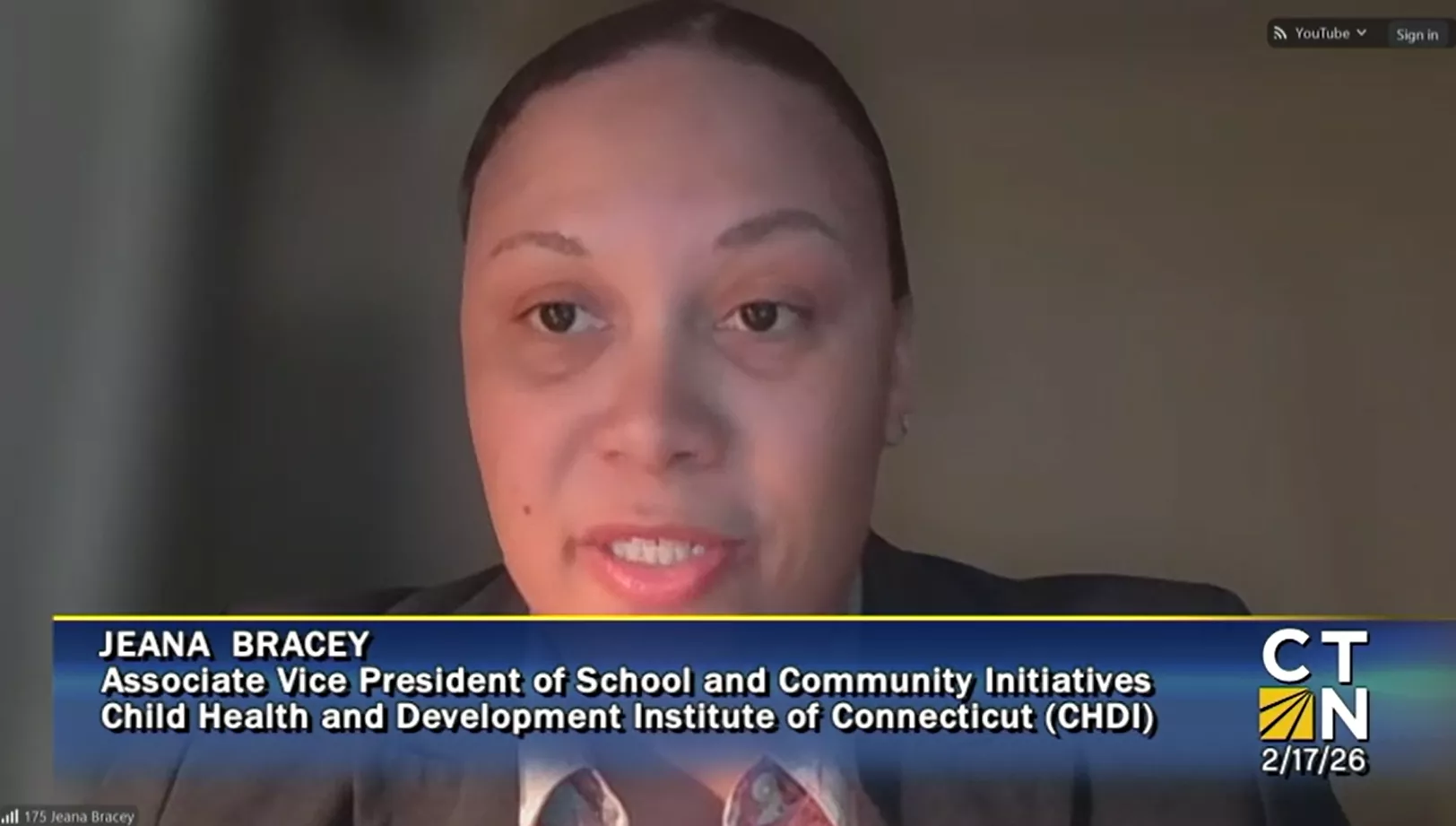
At the beginning of this year's session, a 20% cut to SBDI was proposed by Governor Lamont, which would have resulted in a dramatic decrease in reach and sustainability. In February, Associate Vice President of School and Community Initiatives, Jeana Bracey, PhD, testified before the CGA Appropriations Committee on this proposed adjustment, urging legislators to maintain full funding for the program, while Dr. Vanderploeg submitted written testimony.
Representatives from many schools and districts that have participated in SBDI, including Bridgeport, Danbury, New Britain, Waterbury, Windsor Locks, and West Hartford, joined us by submitting written testimony of the initiative's profound impact on their staff, students, and school communities.
Peer support services have a growing evidence base for improving engagement, empowerment, and recovery in behavioral health services, as addressed in our 2025 Issue Brief Expanding the Impact of Youth and Family Peer Support in Connecticut. Family Peer Support Specialists are caregivers with lived experience navigating behavioral health and related systems who are trained to support other families, while Youth Peer Support Specialists are young adults (18-29) with personal lived experience as children or youth receiving behavioral health services and are trained to support other youth.
Family and youth peer support services have been shown to benefit families and youth by bolstering trust, reducing stress, and increasing engagement, and benefit the system by lowering care costs, reducing hospitalization and emergency room treatment rates, and shortening hospital stays.
In 33 other states, Medicaid is a primary source of funding for family and youth peer support. This legislative session, policymakers raised a bill to make Connecticut the 34th state. On January 15, Aleece Kelly presented on the need to expand Medicaid reimbursement to youth and family peer support services at the 3rd Annual Moving Beyond Implications: Research Into Policy Conference, hosted by the Scholarship Strategy Network and sponsored by CHDI at the Legislative Office Building in Hartford.
In March, Aleece also submitted written testimony to the CGA Human Services Committee in support of bill H.B. 5480: An Act Concerning Peer Support Services Under the Medicaid Program.
Several bills this session addressed Connecticut's Medicaid reimbursement rates. In 2024, the Connecticut Department of Social Services published a study that determined Connecticut's reimbursement rates for behavioral health services were significantly lower than those of five "peer" states.
The number one recommendation in CHDI's 2023 report, Strengthening the Behavioral Health Workforce for Children, Youth, and Families, was to raise salaries to attract and sustain a healthy workforce through sufficient increases to both public and private reimbursement rates.
As part of our behavioral health workforce development initiative, we continue to advocate for higher rates. In March, CHDI President and CEO Jeffrey Vanderploeg, PhD, testified before the CGA Human Services Committee in support of two bills—S.B. 499: An Act Concerning Medicaid Rate Increases and H.B. 5561: An Act Concerning a Five-Year Medicaid Rate Review. Dr. Vanderploeg strongly recommended that the latter be amended to include rates for behavioral health services.
Additionally, in early May, Director of System Development and Policy, Aleece Kelly, MPP, and Dr. Vanderploeg contributed an op-ed on the topic to the CT Mirror.
The Connecticut School-Based Diversion Initiative (SBDI) is a partnership between CHDI and the State of Connecticut designed to prevent in-school arrests and reduce out-of-school suspensions and expulsions for youth experiencing emotional or behavioral health challenges. SBDI has proven to be extremely effective in keeping youth in school, improving academic and behavioral outcomes, and ensuring that all students receive fair, restorative discipline in 82 schools and 29 districts across the state.
At the beginning of this year's session, a 20% cut to SBDI was proposed by Governor Lamont, which would have resulted in a dramatic decrease in reach and sustainability. In February, Associate Vice President of School and Community Initiatives, Jeana Bracey, PhD, testified before the CGA Appropriations Committee on this proposed adjustment, urging legislators to maintain full funding for the program, while Dr. Vanderploeg submitted written testimony.
Representatives from many schools and districts that have participated in SBDI, including Bridgeport, Danbury, New Britain, Waterbury, Windsor Locks, and West Hartford, joined us by submitting written testimony of the initiative's profound impact on their staff, students, and school communities.
Peer support services have a growing evidence base for improving engagement, empowerment, and recovery in behavioral health services, as addressed in our 2025 Issue Brief Expanding the Impact of Youth and Family Peer Support in Connecticut. Family Peer Support Specialists are caregivers with lived experience navigating behavioral health and related systems who are trained to support other families, while Youth Peer Support Specialists are young adults (18-29) with personal lived experience as children or youth receiving behavioral health services and are trained to support other youth.
Family and youth peer support services have been shown to benefit families and youth by bolstering trust, reducing stress, and increasing engagement, and benefit the system by lowering care costs, reducing hospitalization and emergency room treatment rates, and shortening hospital stays.
In 33 other states, Medicaid is a primary source of funding for family and youth peer support. This legislative session, policymakers raised a bill to make Connecticut the 34th state. On January 15, Aleece Kelly presented on the need to expand Medicaid reimbursement to youth and family peer support services at the 3rd Annual Moving Beyond Implications: Research Into Policy Conference, hosted by the Scholarship Strategy Network and sponsored by CHDI at the Legislative Office Building in Hartford.
In March, Aleece also submitted written testimony to the CGA Human Services Committee in support of bill H.B. 5480: An Act Concerning Peer Support Services Under the Medicaid Program.
Wins for Connecticut's Children
Outcomes of Child Welfare Accountability, Transparency, and Reporting Bills
Public Act #26-26—the result of the passage of H.B. 5004: An Act Concerning Child Welfare Accountability and Transparency, effective October 1, 2026—will implement changes to the Connecticut Department of Children and Families (DCF) that aim to enhance service quality for children in their care:
- Financial support for caregivers through the introduction of grant programs to offset the costs of clothing, food, safety items, after-school programs, and child care.
- Workforce support through the establishment of an internship program for prospective social workers and a mentorship program for first-year social workers, with stipends for both mentors and interns.
- Training on perinatal mood and anxiety disorders, human trafficking, trauma-informed practices, cultural sensitivity, and implicit bias.
- Grant funding for postsecondary education for youth who were adopted through DCF or remained in DCF care through age 18.
- A public online dashboard providing real-time data on performance, services, and reports.
- Protection for parents and guardians seeking voluntary mental health treatment, ensuring such treatment cannot be used as the sole basis for DCF action against them.
- Amplification of children's voices during investigations through mandated consideration and documentation of opinions expressed by the child.
- A child welfare policy and oversight committee composed of experts, including legislators, agency commissioners, behavioral health workers, researchers, and caregivers.
Additionally, Public Act #26-48, developed from S.B. 155: An Act Concerning the Recommendations of the Department of Children and Families and the Data Link Connecticut System, will streamline reporting requirements, enhancing transparency and reducing some administrative burden on DCF staff.